BIO
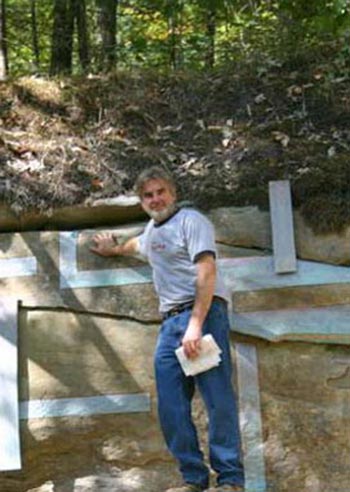
David Phillips was born on January 8, 1944 in Flint, Michigan. A desire to make things rather than representations of them led him from his early training in drawing and painting to sculpture. In 1963, Phillips received a scholarship to The Columbus College of Art and Design in Ohio majoring first in advertising before switching to painting. He then spent four years at Cranbrook Academy of Art, receiving a BFA in painting, 1967 and a MFA in sculpture, 1969. During his Cranbrook years, Phillips visited the Aztec and Mayan architecture in Mexico. In 1968, he received a Mott Foundation Travel Grant to Milan, Italy and the Fonderia Battaglia to study traditional investment casting. At Cranbrook, Phillips studied ceramics with Richard Devore and sculpture with Julius Schmidt. As a student, he taught ceramic sculpture at The Flint Institute of Arts and hand-building at The Bloomfield Art Association. The Cranbrook sculpture department at that time was the largest college metal casting facility in the country. Students were taught the techniques of sand and investment casting as well as the skills to build one's own foundry. Both his painting and sculpture at this time was strictly figurative. Rodin was an inspiration as was Carl Milled and much of Phillips' sculpture was clay modeling using a live model. Future public commissions such as City Square, Charlestown, John Marshall Park, Washington, DC., and Boston Common Frog Pond would utilize this experience with figurative sculpture. After graduating from Cranbrook in 1970, Phillips moved to Cambridge, MA where he constructed his first bronze foundry at the ACT Workshop in Boston while teaching ceramics and sculpture at nearby Neighborhood Arts. A succession of three more foundries followed. His work moved away from the figurative, but remained grounded in nature. At his second foundry, Sculptures Workshop in Somerville, MA Phillips began an art casting business while continuing his own work. In the mid to late 70's many of Phillips' sculptures reflect his interest in technique and process, using diverse materials, elastomers, fiber, leather, and stone in combination with bronze. He exhibited widely in New York and New England. In 1976, he received a Coleman Grant for research in latex. In 1978, he received a MacDowell Colony fellowship where he began a series of wall sculptures incorporating pebbles. A 1979, courtyard installation of sliced boulders, moss, and sand at the Brockton Art Museum began Phillip's use of stone in the landscape. In 1981, he purchased a building in Somerville with two other sculptors after their rented space was sold. This was to be his studio for the next 18 years. In 1983, with funding from NEA, he installed "Bread" at Riverside Press Park in Cambridge. A combination of bronze and large water-worn boulders, "Bread" was the beginning of a series of national public and corporate installations using bronze, stone, water, paving, lighting, and planting. His sculpture had evolved from object making into a broader arena of art making involving special dynamics, public responsibility and collaborative input. This was pivotal work for Phillips. In 1984, "Megaliths" was installed at the MBTA station in Porter Square, Cambridge. In 1985, Phillips sponsored by the USIS, traveled to Japan to lecture at the American Centers in Nagoya and Kyoto. Solo shows in Tokyo, Nagoya, and Kyoto followed, and in 1989, he completed his first Japanese commissions, "Garden of Absence", and "Deconstructed Garden", in Kofu, Japan. Also in 1985, he began a series of sculptures on a remote woodland property in southern New Hampshire. He refers to his body of work as an "experimental workshop". Free from the constraints of the committee system of public art and collaboration, many of his future large scale works were influenced by the ideas he developed in his natural setting. Throughout the 90's Phillips has created public art projects for such venues as Eastern Connecticut State University, Southern Utah University, The University of Southern Maine, Quincy Square Park, Cambridge, MA., the convention center in Shiroishi, Japan, and Boston Common. Among the numerous awards Phillips has received are a Pollock Krasner Grant, Kohler Residency, Boston Society of Landscape Architects Award, and Regional Governor's Design Award. A 1998 fire in his Somerville studio destroyed most of his possessions and artworks. Two years later, he rebuilt establishing Hillside Sculpture Studios in Medford, Massachusetts. With a new foundry, machine shop and stone carving facility at his command, Phillips has completed a series of smaller studio sculptures utilizing natural stone as a "seed" for transformation. While still engaged in public art, Phillips is now nevertheless dramatically shifting towards production of singular objects. These new gallery pieces like his large outdoor works are about spatial relationships. Recently, he has begun to extend forms into space, drawing with bronze, and floating stones with vertical frames. A solo exhibition in 2005 at The Boston Sculptures Gallery featured this new work.